

18kt or 22kt gold: which should you buy in India?
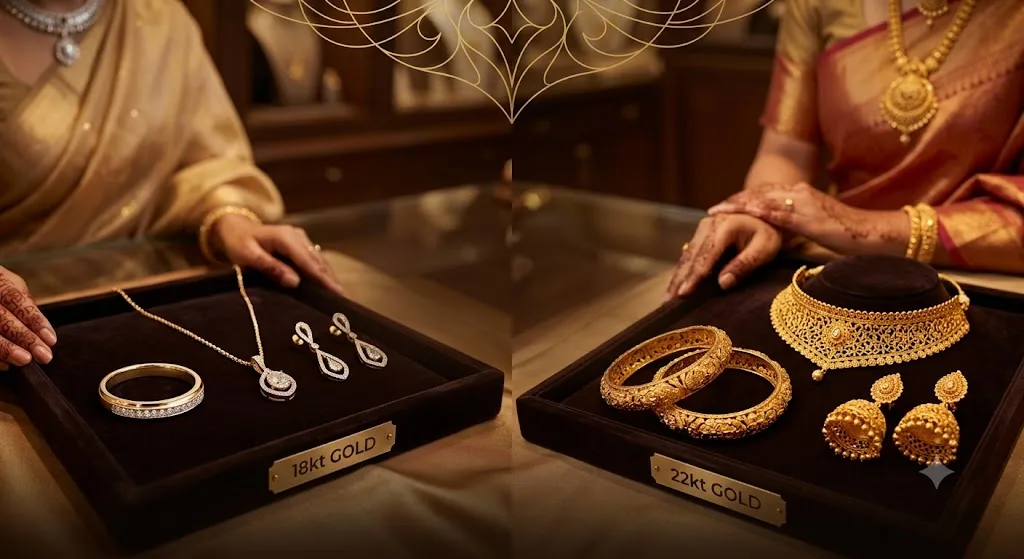
The short version#
Buy 18kt for anything set with diamonds. The claws holding your stones need to be hard.
Buy 22kt for plain gold you intend to keep, exchange or pass on — bangles, chains, a mangalsutra.
Buy 14kt for pieces worn every single day and treated roughly.
Karat changes the gold cost in direct proportion. 22kt carries 22% more gold than 18kt, gram for gram.
Whatever you buy, the bill should show the BIS hallmark, the net gold weight, the rate used and the making charges separately.
What does karat actually measure?#
Karat measures how much of the metal is gold and nothing else. Pure gold is 24 karat. Everything below that is gold mixed with copper, silver, zinc or palladium to make it harder. 22kt is 91.6% gold, 18kt is 75%, 14kt is 58.5% and 9kt is 37.5%. A BIS hallmark is what certifies that the number stamped on your piece is true.
Why pure gold is never used for jewellery#
24kt gold is too soft to hold a shape. A 24kt ring would bend in a trouser pocket, and a 24kt claw would let go of a diamond within months. The alloy is not an adulterant or a way of cheating you — it is the thing that makes a piece wearable. This is why no serious jeweller anywhere in the world sets a stone in 24kt.
Is 22kt better than 18kt?#
No. They are built for different jobs. 22kt holds more gold, so it keeps more resale value and has the deep yellow most Indian buyers recognise as "real" gold. 18kt is harder, so it grips stones securely and survives daily wear without losing its edges. Asking which is better is like asking whether a heavier fabric is better — it depends entirely on what you are making.
Which karat should hold your diamonds?#
18kt, in almost every case. A diamond is held by four to six small metal claws, and those claws are the only thing between your stone and the floor of a Delhi metro station. 18kt is meaningfully harder than 22kt, so the claws keep their tension for years rather than months. Most certified diamond jewellery worldwide is set in 18kt or 14kt for exactly this reason.
If a jeweller offers you a 22kt diamond ring, ask how the stones are secured. There are ways to do it well — heavier bezels, thicker prongs — but it is a deliberate engineering choice that should come with an explanation, not a shrug. You can see how we set stones across our diamond rings and certified diamond collection.
Which karat holds its value best?#
22kt, clearly. Resale and exchange value tracks gold content, so 91.6% purity returns more per gram than 75% does. This is precisely why bangles, chains, kadas and mangalsutras are traditionally made in 22kt: they are worn, but they are also a store of value that a family expects to hold for a generation.
What about 14kt and 9kt?#
They are the right answer far more often than people expect. 14kt at 58.5% is harder still than 18kt and noticeably lighter on price, which makes it excellent for everyday studs, office rings and anything that gets knocked about. 9kt at 37.5% brings the price down further and suits fashion-led designs where the shape matters more than the metal.
The trade-off is honest and worth saying plainly: less gold means less resale value. If a piece is bought to be worn rather than kept, that trade is very often worth making. BIS has hallmarked 9kt gold since July 2025, so a lower karat is no longer an unverifiable purchase.
How much does karat change the price?#
More than most buyers assume, because you pay for the gold that is genuinely there. At a 24kt rate of ₹15,331 per gram, ten grams of finished metal carries roughly ₹1,40,432 of gold at 22kt, ₹1,14,983 at 18kt and ₹89,687 at 14kt — for the identical weight in your hand.
Karat | Purity | Gold in 10g | Best suited to |
22kt | 91.6% | ₹1,40,432 | Bangles, chains, mangalsutra |
18kt | 75.0% | ₹1,14,983 | Diamond rings, pendants, studs |
14kt | 58.5% | ₹89,687 | Everyday wear, office pieces |
9kt | 37.5% | ₹57,491 | Fashion-led, design-first pieces |
Making charges, stones and 3% GST sit on top of the gold figure. What should never happen is a single unexplained number at the end. We publish the full arithmetic for every piece on our transparent pricing page.
What should you check before you pay?#
Five things, and every one of them belongs on the bill rather than in a conversation. If any is missing, ask for it — a jeweller who prices honestly has no reason at all to withhold them.
The BIS hallmark, and that its karat matches what you were told
Net gold weight, not gross — you should never pay the gold rate on a stone's weight
The gold rate used, and the date it was taken
Making charges, shown separately and per gram
For diamonds, the IGI or GIA certificate number
Conclusion: deciding in under a minute#
Ask one question — what is this piece for? If it holds stones, choose 18kt and let the metal do its job. If it is plain gold meant to be kept, exchanged or handed down, choose 22kt and let the purity do its job. If it will be worn every day and occasionally abused, 14kt will outlast both and cost less.
None of these is a lesser choice. The only genuinely wrong decision is buying a karat that does not suit the piece — a soft 22kt setting around a diamond, or a heavy 18kt chain bought as a store of value. Browse the full collection with the karat filter on, and every price you see is broken down before you buy.