

How to Clean Gold Jewelry at Home (the Right Way)
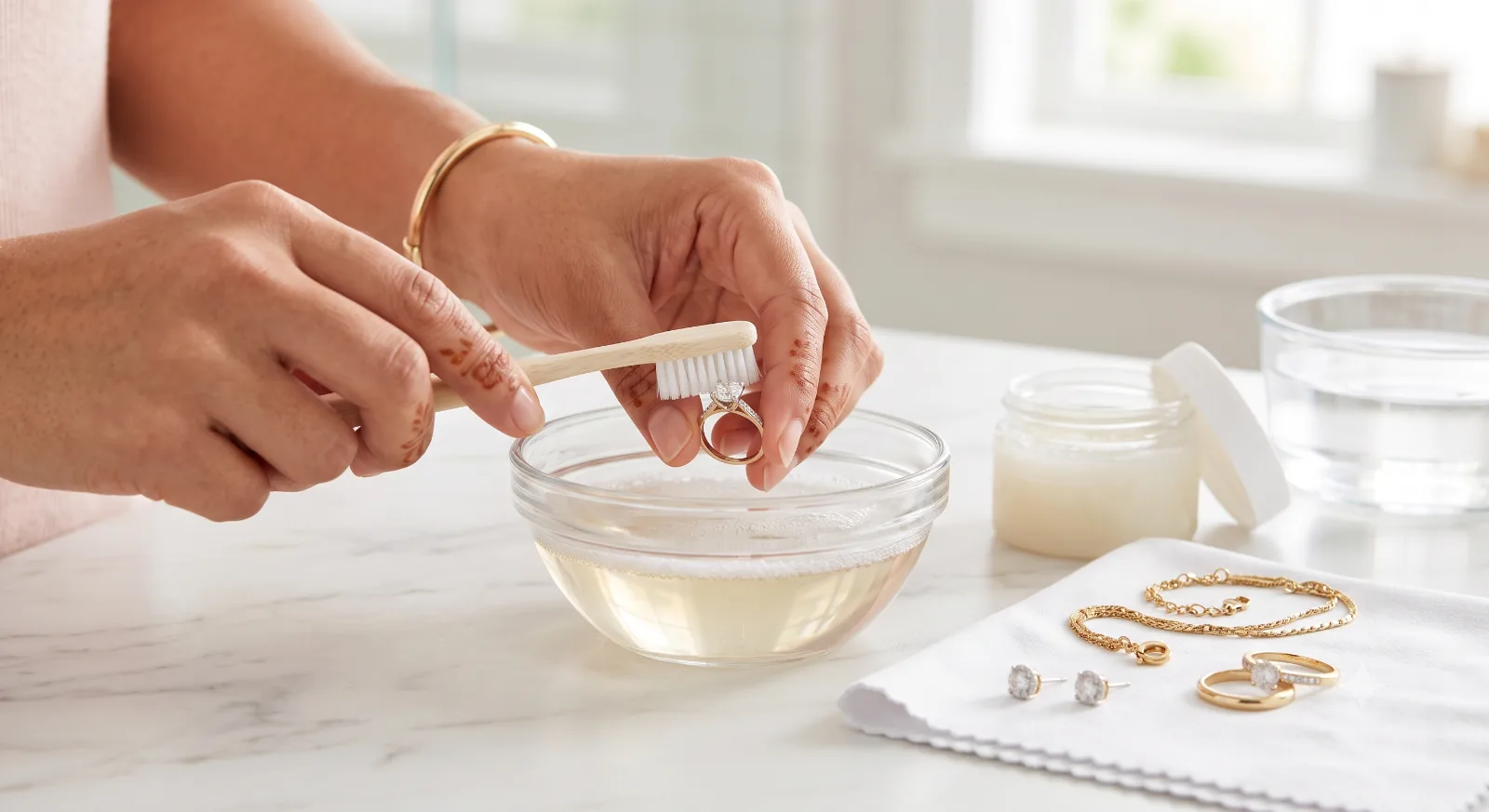
I get this question constantly, usually from someone worried they'll ruin a piece by cleaning it wrong — more often, the risk runs the other way, from not cleaning it, or from reaching for something too aggressive because it promised a faster shine.
Why does gold jewelry lose its shine in the first place?#
It's almost never the gold itself — pure gold doesn't tarnish or corrode. What actually happens:
Everyday buildup. Skin oils, lotion, perfume, and soap residue coat the surface and dull the shine over days of regular wear.
The alloy metals, not the gold. Jewelry gold is never 100% pure — it's alloyed with metals like copper, silver, or zinc for durability, and it's usually those alloy metals reacting slightly with air or skin chemistry that causes the faint darkening some people notice, more so at 8kt or 14kt than at 22kt or 24kt, since lower-karat pieces have proportionally more alloy in the mix. Our own Daily Luxe line runs 8kt and Signature runs 14kt — both durable, everyday metals, and both fine with the method above.
Rhodium wear, on white gold specifically. White gold is yellow gold plated with rhodium to get that bright white color. That plating wears down over months to years of wear and needs periodic professional re-plating — no home cleaning method restores it, because the shine loss there isn't dirt, it's the plating itself thinning.
What's actually safe to use — and what to avoid?#
Method | Safe for plain gold? | Safe with diamonds set in it? | Avoid entirely for |
|---|---|---|---|
Warm water + mild dish soap + soft brush | Yes | Yes | Nothing — this is the default method |
Ultrasonic jewelry cleaner | Usually | Usually, for well-set diamonds | Emeralds, opals, pearls, turquoise, and any stone with visible inclusions or fracture-filling — vibration can widen existing cracks |
Steam cleaner | Usually | Usually | Same stone list as ultrasonic, plus any glued (not prong-set) stone |
Toothpaste or baking soda paste | No | No | Everything — both are mildly abrasive and will micro-scratch gold over repeated use, even though it's a common home tip |
Chlorine bleach or household cleaning sprays | No | No | Everything — chlorine actively pits and weakens gold alloys, and can damage stone settings |
Alcohol-based cleaners (perfume, hand sanitizer residue) | Not ideal | Not ideal | Anything you're wearing daily — wipe residue off rather than let it sit, but don't use these as a deliberate cleaning method |
The honest trade-off here: ultrasonic and steam cleaners are faster and get into detail work that a toothbrush can't always reach, and we use them ourselves for the right pieces. But they're not universally safe, and a lot of at-home ultrasonic units don't let you control intensity the way a jeweler's equipment does. If a piece has an emerald, opal, pearl, or a diamond we've flagged as having visible inclusions, warm soapy water by hand is the safer call every time — even if it's slower.
Does the cleaning method change for diamonds versus other stones?#
For diamonds specifically — natural or lab-grown, it makes no difference to how you clean them, since they're chemically and physically identical (more on that in our lab-grown diamond guide if you're curious) — warm soapy water and a soft brush is genuinely enough. Diamonds are the hardest natural material there is, so they're close to impossible to scratch through normal cleaning. The setting is the more fragile part: check that prongs are intact before soaking anything, because a loose prong plus a soak-and-brush routine is how stones get knocked loose, not lost to the cleaning itself.
Softer or more porous stones — pearls, opals, turquoise, coral, and some emeralds — are a different story. Skip soaking entirely. A barely damp, soft cloth wipe is the safer method, and even that should be done gently and left to air-dry.
How often should you actually clean gold jewelry?#
For pieces worn daily — a wedding band, an everyday chain — every 2–3 weeks is reasonable. For occasional-wear pieces, cleaning before and after each wear is usually enough. There's no real downside to cleaning too often with the warm-water method; the risk only shows up with abrasive or chemical shortcuts, not with plain soap and water done more frequently.
Beyond home cleaning, we'd still recommend a professional check-up once or twice a year — not for the shine, but for the things you can't see yourself: prong wear, clasp integrity, and stone security. That's a five-minute visual inspection any jeweler can do, ours included, and it catches problems while they're still a quick fix rather than a lost stone.
Do you need special products, or is soap and water really enough?#
Soap and water is really enough for the vast majority of gold jewelry. We don't sell or push a branded cleaning solution, because there isn't a meaningful gap between dish soap and most commercial "jewelry cleaning solutions" for plain gold and well-set diamonds — you'd mostly be paying for packaging and scent. Where a specialized product does earn its place is stone-specific care (a pearl-safe cloth, for instance) — and even there, the safest default if you're unsure is to skip the product and bring it in instead.
Common questions
Can I use toothpaste to clean gold jewelry?
We wouldn't recommend it, despite how common the tip is. Most toothpaste contains mild abrasives meant for tooth enamel, which is far harder than gold — repeated use will dull the surface with fine scratches over time. Warm water and dish soap does the same job without that risk.
Is it safe to clean gold jewelry with diamonds in an ultrasonic cleaner?
Usually, if the diamond is well-set with no visible inclusions and the setting itself is sound — check prongs first. It's not safe for emeralds, opals, pearls, turquoise, or fracture-filled stones, where vibration can worsen existing internal cracks. When in doubt, warm soapy water by hand is the safer default.
How do I clean gold jewelry that's turned slightly dark?
Soak it a bit longer — 15–20 minutes instead of 10 — in warm water and mild dish soap, then brush gently. That darkening is almost always the alloy metals (copper, silver, or zinc mixed into the gold), not the gold itself, and it comes off with the same method. If it doesn't lift after a couple of tries, that's worth a professional look rather than reaching for something stronger.
Does 8kt gold need different cleaning than 14kt or 18kt gold?
No — the cleaning method is identical across purities. Lower-karat gold (like our 8kt Daily Luxe line) has more alloy metal mixed in than higher-karat gold (like our 14kt Signature line), which can mean slightly more noticeable everyday buildup between cleans, but not a different cleaning process.
How do I clean white gold jewelry specifically?
The same warm-water method is fine for surface cleaning, but it won't fix dulling caused by worn rhodium plating — that's a re-plating job, not a cleaning one. If a white gold piece looks yellowish or dull no matter how you clean it, that's the plating wearing thin, and it's a normal, expected maintenance step rather than a flaw in the piece.
Written by

Abhay Khurana
Co-Founder, Aarvines Jewells
Before co-founding Aarvines, Abhay spent over a decade running an international growth-marketing agency working with 100+ brands. He now personally oversees pricing, certification and sourcing at Aarvines, and fields most customer questions on cost and quality directly.