

Lab-Grown vs Natural Diamonds: The Honest Price Difference
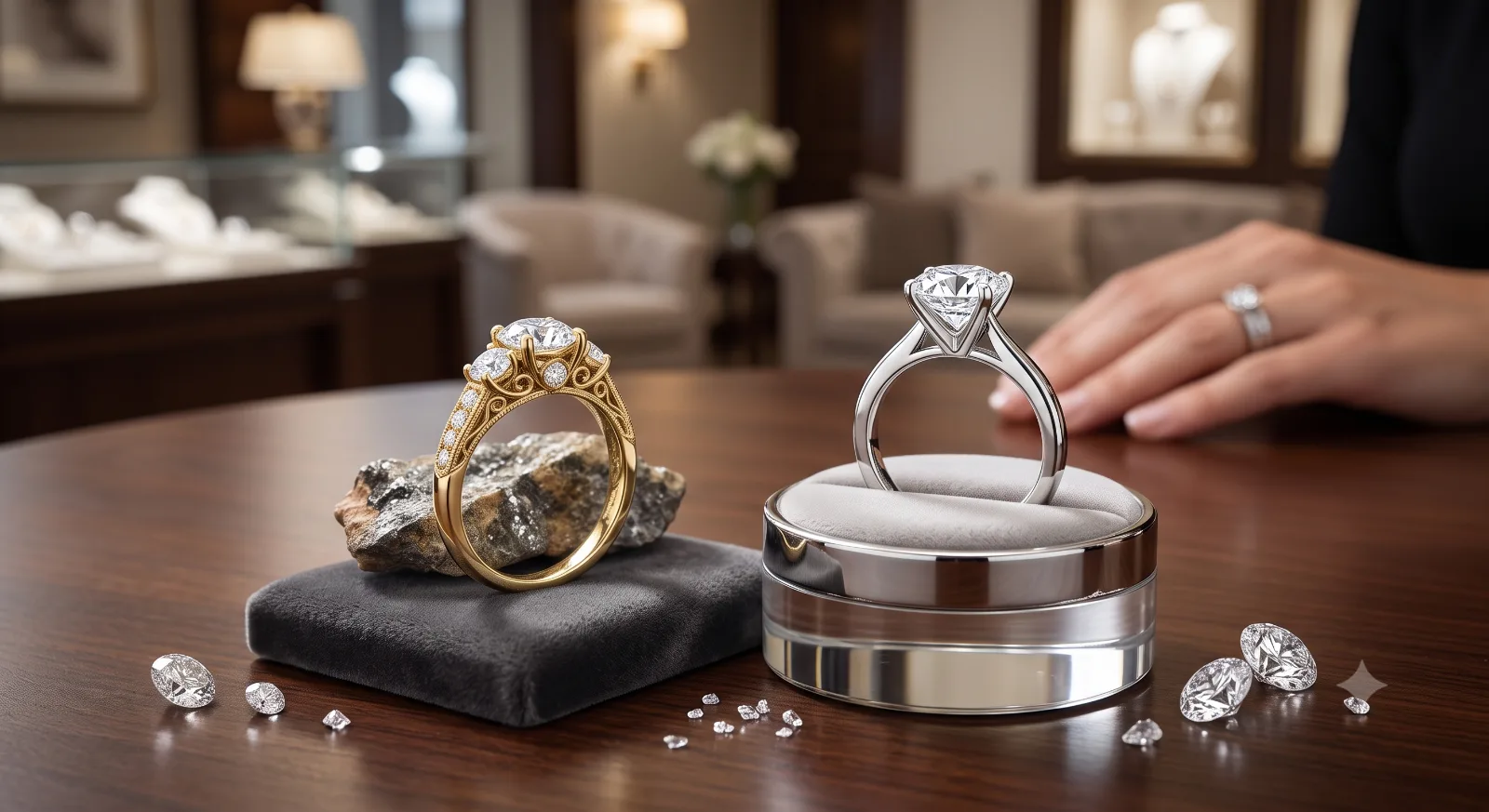
Why is there such a big price gap if the diamonds are chemically identical?#
A natural diamond formed 1–3 billion years ago, was mined, cut, and moved through a supply chain built around scarcity — that scarcity is what you're paying for, not superior physical properties. A lab-grown diamond is grown in weeks using CVD or HPHT technology that replicates the same pressure and heat conditions underground, then cut and polished the same way. Strip away the mining and the decades of market positioning around rarity, and you're left with the actual cost of production — which is a fraction of what it costs to find and extract a natural stone.
Gemologically, IGI and GIA grade both types on identical scales — cut, color, clarity, carat. Neither lab is grading lab-grown diamonds on a curve.
How much cheaper are lab-grown diamonds, in real terms?#
The 40–60% figure holds fairly consistently across carat sizes, though the gap tends to widen as size increases, since natural diamonds get disproportionately rarer — and pricier — the larger they get.
Carat | Natural (indicative) | Lab-grown (indicative) | Typical gap |
|---|---|---|---|
0.50 ct | Higher end of budget band | 40–50% less | Narrower gap |
1.00 ct | Mid-to-premium band | 45–55% less | Widens |
1.50 ct+ | Premium band | 50–60% less | Widest |
We're keeping these as bands, not fixed rupee figures, on purpose — gold and diamond costs move with live market rates (that's the whole point of our Open Pricing model, where every product page shows the current gold rate, stone cost, and making charges itemized). If you want the exact number for a specific stone, that's a two-minute conversation, not a guess from a blog post.
Does cheaper mean lower quality?#
No — and this is the part worth being direct about. A well-cut, well-graded lab-grown diamond can outperform a poorly cut natural diamond of the same carat weight on actual sparkle. Quality is a function of the 4Cs, full stop, regardless of origin. What you're not getting with a lab-grown stone is geological rarity — and depending on what you value, that's either irrelevant or the entire point.
What's the actual trade-off? (Because there is one)#
Here's the honest part: lab-grown diamonds don't hold resale value the way natural diamonds can. The secondary market for diamonds generally isn't great for either type — diamonds aren't a liquid investment — but natural diamonds retain a floor of value tied to their rarity that lab-grown stones largely don't have yet, since lab-grown supply can scale in a way natural supply can't. If you're buying primarily as a long-term store of value, that's a real factor. If you're buying for how the piece looks and feels to wear, it's close to irrelevant. We tell customers this plainly rather than letting them find out later — it's the same reason our pricing is itemized instead of a single bundled number.
Which one should you actually choose?#
There's no universally right answer, and we don't push people toward one over the other. Lab-grown makes sense when you want more size or better clarity for the same budget, or when the origin story matters less to you than the look. Natural makes sense when rarity, tradition, or long-term resale potential matter to you specifically — some customers want a stone that's a few billion years old, and that's a legitimate reason on its own. Both are IGI/GIA certified when they leave us, both are priced with the same transparent breakdown, and both sit in our collections without one being marketed as the "premium" choice.
See the actual numbers#
Every product page on aarvinesjewells.com shows the live gold rate, the certified stone cost, and making charges broken out — not a single bundled price. Browse natural diamonds or lab-grown diamonds to compare real, current pricing side by side, or read the full Open Pricing model to see exactly how we calculate every number. If you want a certified piece built to your own carat and budget, our custom jewellery process starts with a transparent quote before anything goes into production.
Common questions
Are lab-grown diamonds real diamonds?
Yes. They're carbon crystallized into the same structure as natural diamonds, graded on the same cut/color/clarity/carat scale by the same labs (IGI, GIA). The only difference is where the crystal formed — underground over billions of years, or in a controlled lab environment over weeks.
Do lab-grown diamonds hold their value like natural diamonds?
Not as reliably. Natural diamonds retain more resale value due to geological scarcity; lab-grown supply can scale, which keeps resale prices softer. Neither is a strong investment vehicle — buy either for the piece, not as a financial asset.
Can you tell a lab-grown diamond apart from a natural one just by looking?
No, not with the naked eye or a standard loupe. Telling them apart requires specialized lab equipment that detects trace growth patterns — which is exactly why certification (IGI, GIA) matters more than visual inspection.
Why do some jewellers price lab-grown diamonds closer to natural ones?
Some do — often because they're pricing off perceived value rather than actual production cost. We price both types the same way: gold cost, stone cost at certified market rate, and making charges, all itemized. If a lab-grown price looks close to natural for the same specs, ask to see the breakdown.
Will the price gap between lab-grown and natural diamonds stay the same over time?
It's likely to shift as lab-grown production scales further and becomes even more efficient — most signs point to the gap staying wide or widening, not narrowing. We don't have a crystal ball on this, so treat it as a current-market answer, not a permanent one.
Written by

Abhay Khurana
Co-Founder, Aarvines Jewells
Before co-founding Aarvines, Abhay spent over a decade running an international growth-marketing agency working with 100+ brands. He now personally oversees pricing, certification and sourcing at Aarvines, and fields most customer questions on cost and quality directly.