

Are Lab-Grown Diamonds Real? The Honest Answer
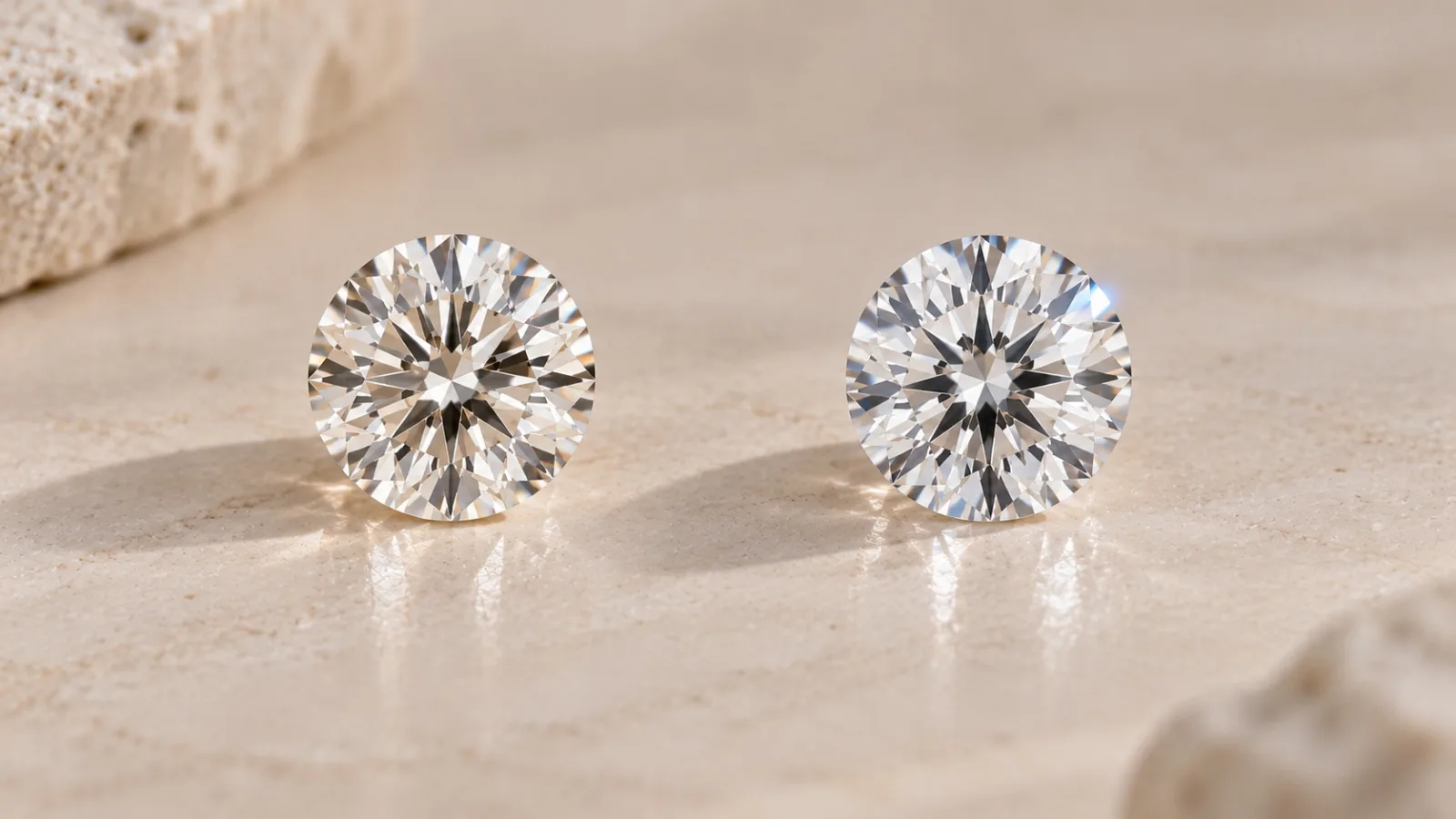
I get some version of this question almost every week, usually from someone standing at a case looking at two rings that look exactly the same but cost very differently. Here’s exactly what’s going on.
What makes a lab-grown diamond a “real” diamond?#
A diamond is just carbon atoms arranged in a specific crystal lattice under extreme heat and pressure. Nature does this over a billion-plus years, tens of kilometres underground. A lab does the same physics in weeks, in a controlled chamber. The atoms don’t know the difference, and neither do the diamond’s optical properties — hardness, refractive index, how it scatters light.
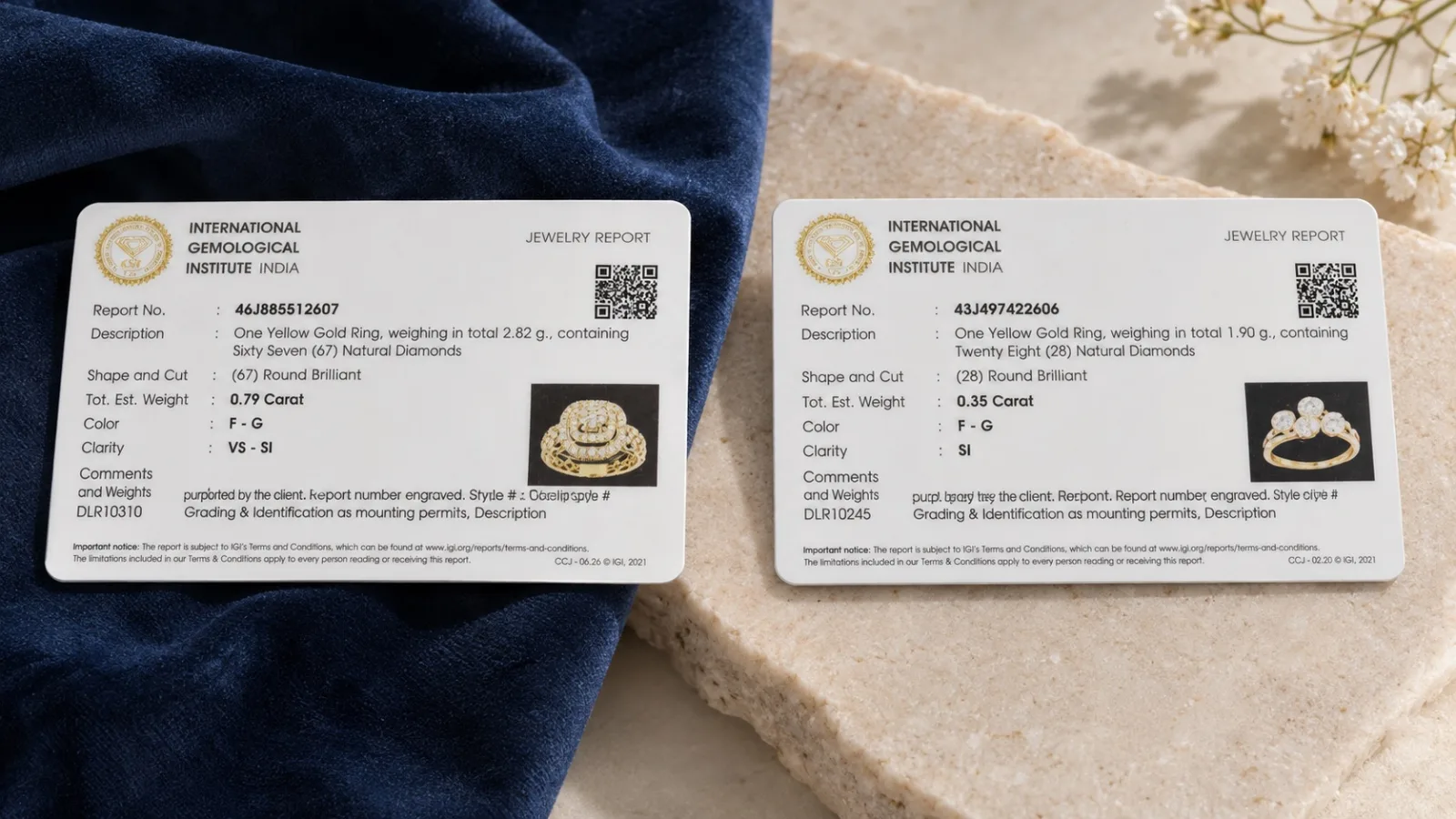
This isn’t a marketing claim we’re making up — it’s why the certification bodies (GIA, IGI) grade lab-grown diamonds on the exact same 4Cs scale as natural ones, and issue the same style of report either way, just labelled “laboratory-grown.”
How are lab-grown diamonds actually made?#
Two methods, both producing genuine diamond:
CVD (Chemical Vapour Deposition) — a thin diamond seed is placed in a chamber filled with carbon-rich gas. The gas is heated until carbon atoms break free and settle onto the seed, layer by layer, building the crystal from the bottom up over several weeks.
HPHT (High Pressure, High Temperature) — a carbon source is subjected to conditions that mimic the earth’s mantle: extreme pressure and heat, which forces the carbon to crystallise into diamond form. This is closer to how nature does it, just compressed into a much shorter timeframe.
Both produce a genuine diamond. Neither produces a “simulant” — that word describes something like cubic zirconia, which only looks like a diamond but has a completely different chemical structure. A lab-grown diamond isn’t a diamond simulant; it’s a diamond.
Are lab-grown diamonds cheaper than natural?#
Yes, meaningfully — typically 40–60% less than a natural diamond of comparable cut, colour, clarity and carat. This is the honest number, not a rounded-down marketing figure, and it’s worth understanding why: natural diamond pricing carries the cost of geological rarity and the entire mining, sorting and distribution chain built around scarcity. Lab-grown diamond supply can scale with demand, so the price reflects production cost rather than scarcity.
That gap is exactly why we sell both natural and lab-grown side by side rather than pushing one over the other — a customer who wants the largest, cleanest stone for their budget usually goes lab-grown; a customer for whom “formed over a billion years” is part of the meaning goes natural. Both are correct answers, they’re just answering different questions.
The trade-off I won’t dodge: resale value#
Here’s the part most jewellers gloss over, and I’d rather just say it plainly. Lab-grown diamonds do not currently hold resale value the way natural diamonds do. Natural diamonds have an established secondary market built over a century; lab-grown supply is newer and still scaling, so the resale market for it is thin and prices have been falling as production efficiency improves. If you’re buying primarily as a long-term store of value, that’s a real factor, not a footnote.
If you’re buying for how the piece looks and what it means to you rather than as an investment, this trade-off matters a lot less — most engagement rings and everyday jewellery are never resold anyway. But you should know it going in, not find out later.
Is moissanite a lab-grown diamond?#
No, and this is a common mix-up worth clearing up directly. Moissanite is a different mineral entirely — silicon carbide, not carbon — that’s grown in a lab because natural moissanite is vanishingly rare. It looks similar to a diamond at a glance but has a noticeably different sparkle (more rainbow-coloured flash, less white brilliance) and different hardness. A lab-grown diamond is chemically a diamond; moissanite never was one.
Natural vs. lab-grown diamonds, side by side#
Natural Diamond | Lab-Grown Diamond | |
Chemical composition | Pure carbon crystal | Identical — pure carbon crystal |
Formation | 1–3+ billion years, deep underground | Weeks, in a controlled lab (CVD or HPHT) |
Optical properties | Fire, brilliance, hardness | Identical |
Typical price vs. equivalent natural | Baseline | 40–60% less |
Resale/secondary market | Established | Thin, still developing |
Certification | GIA, IGI (graded on the 4Cs) | GIA, IGI (same scale, labelled “laboratory-grown”) |
Best for | Buyers for whom origin/rarity is part of the meaning | Buyers who want more stone for the budget |
What this means for how you buy#
If you’re choosing between the two, the honest framework is this: decide what you’re actually optimising for. If it’s size and clarity per rupee, lab-grown wins clearly. If origin and long-term resale matter to you, natural is the right call even at a higher price. Neither is the “smarter” choice in the abstract — it depends on what you want the piece to mean.
Whichever direction you go, always ask for the certification report and check it yourself rather than taking a jeweller’s word for it — both GIA and IGI let you verify a report number directly on their own sites in under a minute. We show you the report on every certified piece precisely so you don’t have to take our word for anything — it’s the same principle behind how we price every piece.
FAQ#
Is a lab-grown diamond a real diamond, or just diamond-like? It’s a real diamond — same carbon crystal structure, same hardness and optical properties as a natural diamond. The only difference is where and how fast it formed.
Do lab-grown diamonds get certified the same way as natural ones? Yes. GIA and IGI grade lab-grown diamonds on the same 4Cs scale (cut, colour, clarity, carat) and issue a report either way — lab-grown reports are simply labelled as such.
Will a lab-grown diamond pass as natural if I don’t disclose it? It shouldn’t be sold that way, and a legitimate jeweller never will — the certification report states the diamond’s origin clearly, and gemological equipment can distinguish the two even when the eye can’t.
Do lab-grown diamonds hold their value over time? Not as well as natural diamonds currently do — the resale market for lab-grown stones is newer and thinner, and prices have trended down as production has scaled. Worth knowing if resale matters to your decision.
Can I see natural and lab-grown options side by side before deciding? Yes — we deliberately show both on every applicable piece rather than steering you toward one. Browse lab-grown and natural diamond options, or check how each piece is certified.
About the author
Abhay Khurana is Co-Founder of Aarvines Jewells. Before co-founding Aarvines in 2025, he spent over a decade running an international growth-marketing agency, working with 100+ brands since 2011 — an outsider’s eye on an industry that isn’t always transparent about how it prices and certifies what it sells. At Aarvines, Abhay personally vets certification, pricing and sourcing on every piece.
Written by

Abhay Khurana
Co-Founder, Aarvines Jewells
Before co-founding Aarvines, Abhay spent over a decade running an international growth-marketing agency working with 100+ brands. He now personally oversees pricing, certification and sourcing at Aarvines, and fields most customer questions on cost and quality directly.